
Most people are worried about getting out of their existing mortgage and into a new one, at a higher rate. Maybe it’s not that bad if you “do the math” slightly differently. Delaying an important real estate move or not getting into your “Dream home” may be easier to solve now than most people think. If the money for your next down payment is coming from the home we’re selling, I like to sit down and walk through the numbers first, because waiting often costs more than people expect.
Your Down Payment: Why the Dollar Amount Matters More Than the Percent
Once your home closes, your down payment becomes a fixed number. If your next home costs more by the time you’re ready, that same check covers a smaller slice of it. You end up borrowing more, and once you’re under 20% down, you’ll probably pay mortgage insurance as well. That’s the piece of the “wait for rates” plan most people miss.

Today’s Numbers: Where Rates and Prices Sit This Fall
The average 30-year fixed rate was 7.32% the week of October 22, according to Freddie Mac. Fannie Mae’s October forecast doesn’t see much relief soon, with rates around 7.4% to 7.5% into 2027. The experts in Fannie Mae’s latest Home Price Expectations Survey still expect national prices to rise roughly 2% to 3% a year. Here in Ferndale/Custer, the median single-family sale in September was $650,000, according to NWMLS data.
Two Paths: Walking Through a Ferndale Example
Let’s say your sale nets you $130,000, which is 20% of a $650,000 home in Ferndale. If you buy now at 7.32%, your loan is $520,000 and your principal and interest run about $3,572 a month. Or you rent and wait three years. If home prices rise 2.5% a year, that same home costs about $700,000, and your $130,000 is now only 18.6% down on a $570,000 loan. These are illustrations, not predictions.
| Three years from now | You bought now | You waited |
|---|---|---|
| Home value | about $700,000 | about $700,000 |
| Loan balance | about $503,900 | about $570,000 (new loan) |
| Your equity | about $196,000 | $130,000 |
| Monthly P&I if rates fall to 6.5% | about $3,185 (after refinancing) | about $3,603 |
| Monthly P&I if rates stay at 7.32% | about $3,572 (no refinance) | about $3,915 |
These figures cover only the monthly loan payment on a 30-year fixed mortgage, before taxes, insurance, mortgage insurance, and selling costs.
The Refinance: Helpful, but Never Guaranteed
If rates do fall to 6.5%, refinancing that $503,900 balance would lower your payment by about $387 a month. With closing costs of 1% to 2% of the loan, roughly $5,000 to $10,000, you’d break even in about 13 to 26 months. If rates never come down, you simply keep your loan, and in this example you’re still ahead of the waiting path. What would change my advice is a real price drop. If prices fell 5% instead, the waiting path would come out with the lower payment. Prices haven’t risen everywhere around here lately, so I look closely at the town you want before we decide.
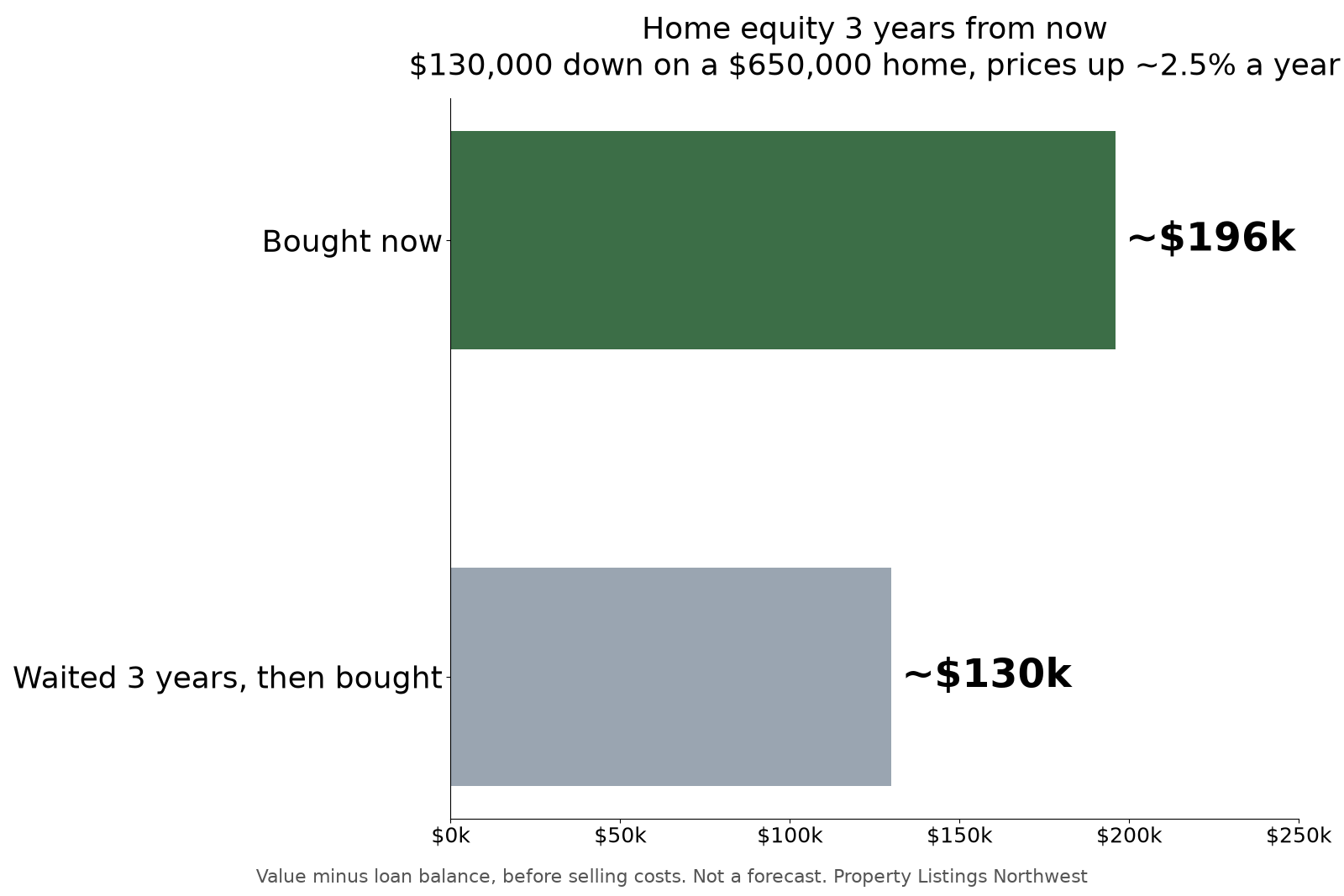 How equity compares in my Ferndale example.
Putting It All Together
If your sale proceeds already reach that 20% mark or more on the home you want, buying now usually leaves you with a smaller loan, more equity, and the option to refinance later. It does mean carrying a higher payment for a while, so I want you to have steady income and solid reserves. Before you decide, please talk with your lender about rates and refinance costs, and ask a tax professional about mortgage interest and property taxes.
Selling and buying at the same time? Reach out to me. I’ll run these numbers with your real sale proceeds and the towns you’re looking at, and we’ll figure out which path fits you best.